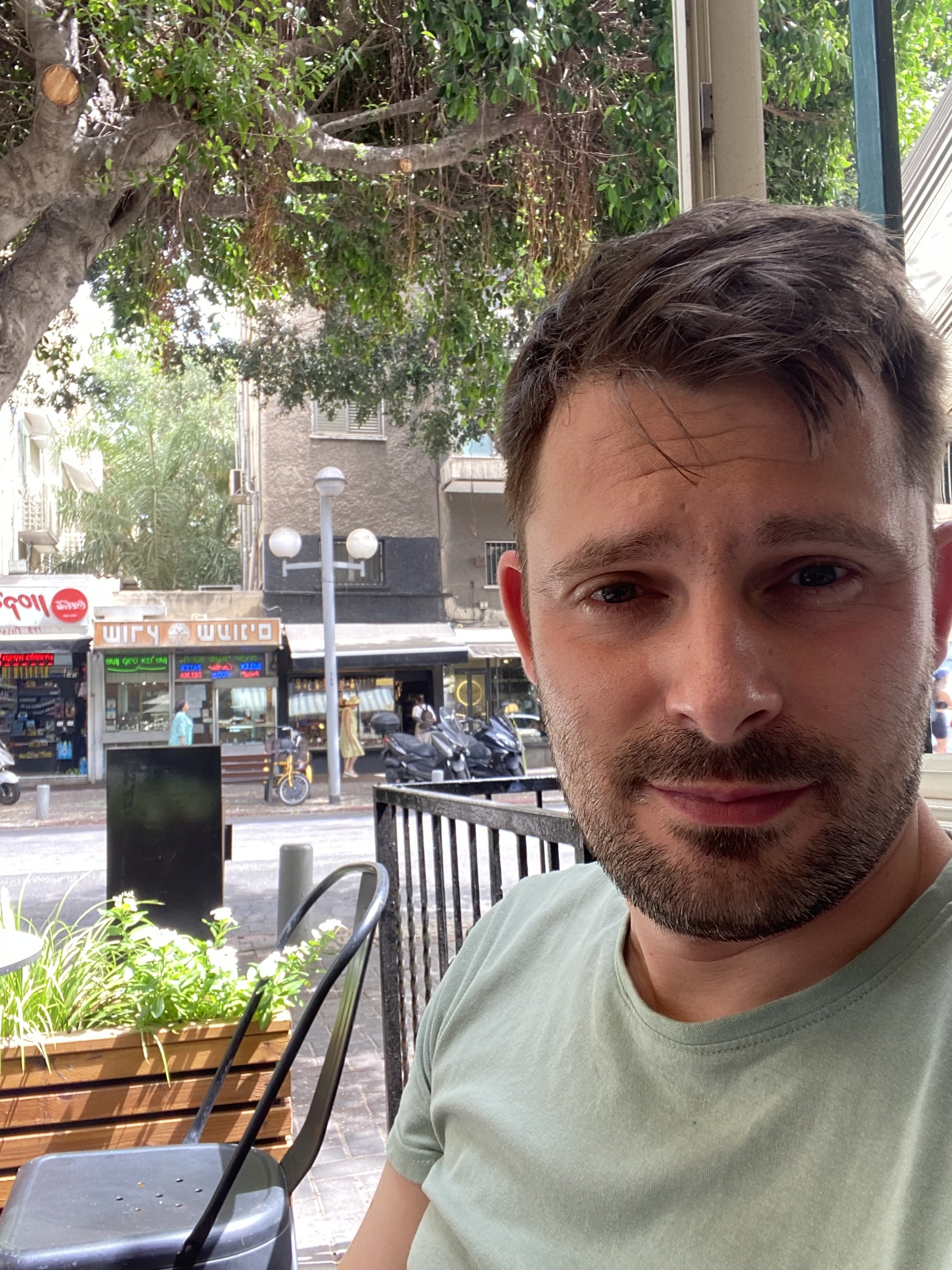
MACIEK GDULA
Classicist & Ancient Greek Educator
PROFESSIONAL PROFILE
Maciek Gdula is a philologist and scholar of history specializing in immersive, active-language pedagogy. His teaching unites philological precision with living fluency: close attention to idiom, particle combinations, neologisms, and the differences between Attic and Koine. A student of Classical Chinese as well as Ancient Greek, he maintains a comparative interest in the two literary traditions.
ACADEMIC EDUCATION
• M.A. in Classics – University of Warsaw (expected 2026).
• Fluency in Ancient Greek (Emphasis in Teaching Ancient Languages Track) – The Polis Institute, Jerusalem (2022–2024).
• Chinese Language Program – Tsinghua University, Beijing (2010–2012).
• Department of History Exchange – McGill University, Montreal (2008–2009).
• B.A. in History & Political Science – University of Nottingham (2007–2010).
TEACHING EXPERIENCE
Ancient Greek School: Founder & Teacher (2024–Present).
• Teaches Ancient Greek as a living language at every level, reading authors from Homer to the Attic orators, and produces fully subtitled video commentaries entirely in the language.
The Polis Institute: Instructor, Ancient Greek Lunch Sessions (2024).
• Led the weekly sessions, combining classical texts with modern compositions in Ancient Greek, ranging from Blackie’s dialogues to the Harry Potter translation.
Google: English Language Facilitator, Beijing (2012).
• Authored the curriculum for an advanced conversational language course and taught it to Google China employees.
RESEARCH & SPECIALIZATION
• The Greek Novel & Epistolography: Academic interests in prose fiction, dialogue, and the texture of everyday life in antiquity, with an M.A. thesis on the Letters of Phalaris.
• Cognitive Science & Language Acquisition: The application of research on memory and processing to the teaching of ancient languages, with a presentation at the graduate conference “Teaching Past and Present: Classical Languages and Ancient Culture” (University of Warsaw, 2022).
• Textbooks & Editorial Work: Co-editor of the Polis Institute’s forthcoming Ancient Greek textbooks (levels 5–6) and editorial contributor to the Ἕν, δύο, τρία reader.
• Digital Philology: The development of a modern typing, autocomplete, and spell-checking application for Ancient Greek, informed by a decade in senior technology positions.
• History & International Affairs: Abackground in history, political science, and international relations, with research work at the Carnegie Endowment for International Peace, the Woodrow Wilson International Center for Scholars, and the James Martin Center for Nonproliferation Studies.
LANGUAGE PROFICIENCY
• English & Polish: Native.
• Ancient Greek: Full Professional Fluency.
• Mandarin Chinese: Advanced.
• Latin, Spanish & French: Proficient.
• Classical Chinese & Egyptian Hieroglyphs: Academic Knowledge.