 Image 1 of 1
2. Course Overview
Abstract: This fifth level deepens your grammatical and conversational command of Attic Greek. Students explore the political and social dimensions of Ancient Greece, from the assembly (ekklesia) to the historical accounts of Herodotus. Through an inductive-contextual approach, the curriculum focuses on applying complex subordinate constructions and advanced verb forms in active dialogue.
Comprehensive Description: Building on the grammar introduced in Level 4, this course deepens your reading fluency through the rich narrative content of Chapters XXI–XXV. Topics include advanced verb systems and increasingly complex syntactical dependencies. Students will continue actively using the target language in rhetorical exercises, composing ekphrasis, creating paraphrases, and structuring imagined dialogues based on the text. To further internalize the language, participants are encouraged to read aloud and memorize extended passages from classical authors.
3. Methodology & General Description
This course utilizes the second or third English editions of Athenaze; as the variations between these editions are negligible, both are suitable for the curriculum. Each twelve-week term consists of bi-weekly sessions comprising two academic hours (90 minutes total).
As a unique pedagogical complement to the Athenaze series, our approach integrates modern communicative language learning with century-old practices inherited from late antiquity and the Byzantine era. Students are expected to prepare for each session by reading 10–15 lines of the assigned text. During class, these lines become the basis for active practice:
Active Dialogue: Students formulate and answer questions entirely in Ancient Greek, discussing civic events, education, and historical narratives.
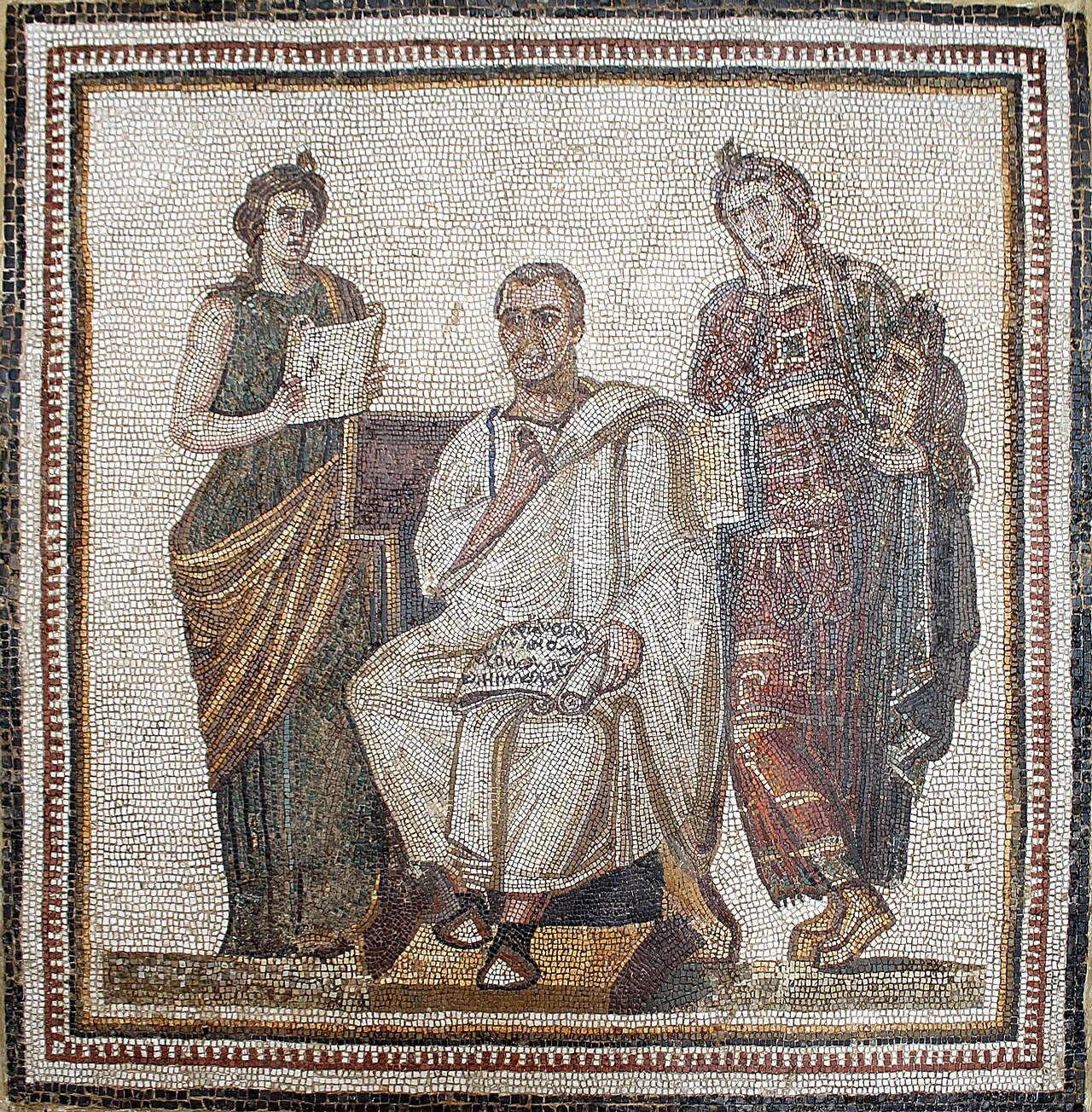
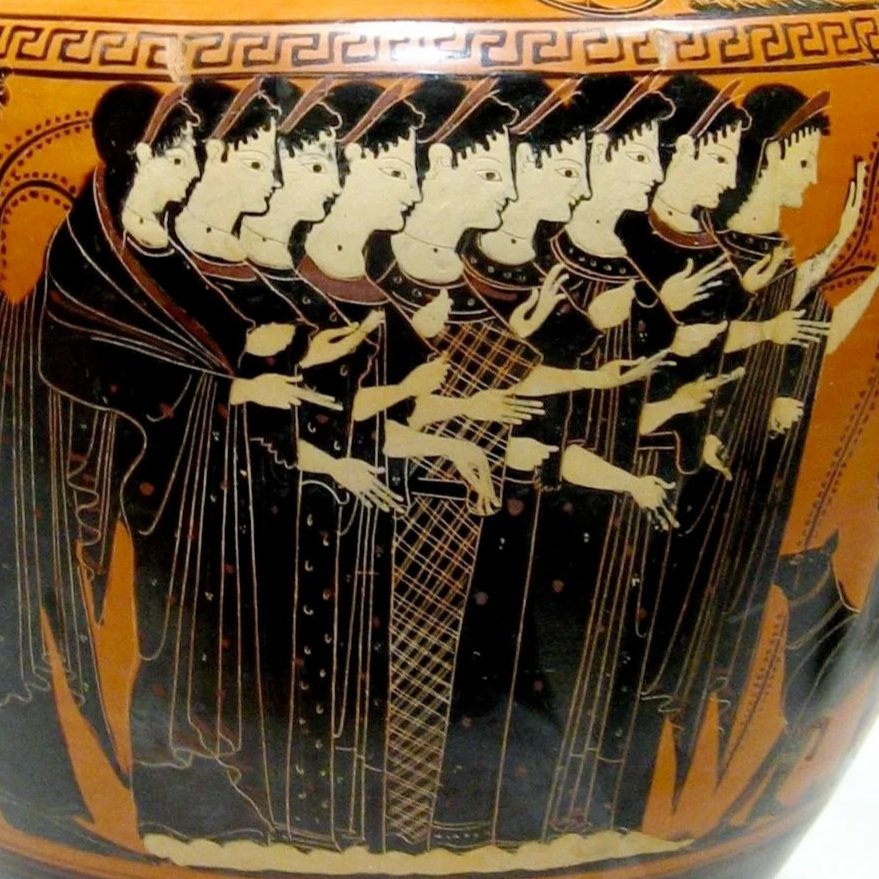
Visual Elicitation: Describing imagery related to Athenian public life to bypass translation.
Linguistic Reformulation: Rewriting passages through personal paraphrases and targeted grammar drills to internalize complex subordinate clauses.
Internalization: Gradually memorizing key dramatic dialogues and classical fragments to absorb the natural rhythm of the language.
Through these exercises, participants acquire not only the book’s lexicon but also the target-language terminology necessary to discuss advanced grammatical structures and express nuanced opinions in Ancient Greek.
4. Proficiency & Requirements
Language Level:
Framework Reference: Upper-Intermediate — Level 5 (Athenaze Vol. II, Chapters XXI–XXV).
General Description: Designed for students who have successfully completed Level 4 or equivalent. Participants must have a firm command of the active and middle future tenses and practical familiarity with athematic $-\mu\iota$ verbs.
Estimated Self-Study Time:
Time Commitment: Approximately 3–4 hours per week (including 20 minutes of daily review).
Preparation: Preliminary reading of 10–15 lines from the assigned passage is required before each session.
5. Materials & Bibliography
Required Textbooks:
Primary Text: Maurice Balme & Gilbert Lawall, Athenaze: An Introduction to Ancient Greek, Vol. II (2nd or 3rd English Edition).
Disclaimer: Acquisition of the physical or digital edition is mandatory for course attendance. Please ensure you have your copy before the first session.
Grammatical Syllabus:
Morphology & Syntax: Advanced verb paradigms; formulation and application of complex subordinate clauses (purpose, result, conditional, and temporal clauses); advanced participle usage in historical narrative.
Classroom Metalanguage: Continued active application of rhetorical and grammatical terminology in Ancient Greek to construct extended paraphrases and dialogues.
6. Chapter Coverage & Readings
This module covers approximately 301 verses of narrative text (~12 verses per session):
XXI. ἡ ἐκκλησία (α-β): 79 verses.
XXII. ἡ ἀνάστασις (α-β): 61 verses.
XXIII. ἡ ἐσβολή (α-β): 49 verses.
XXIV. ἐν διδασκάλων (α-β): 58 verses.
XXV. ὁ Κροῖσος τὸν Σολῶνα ξενίζει (α-β): 54 verses.